
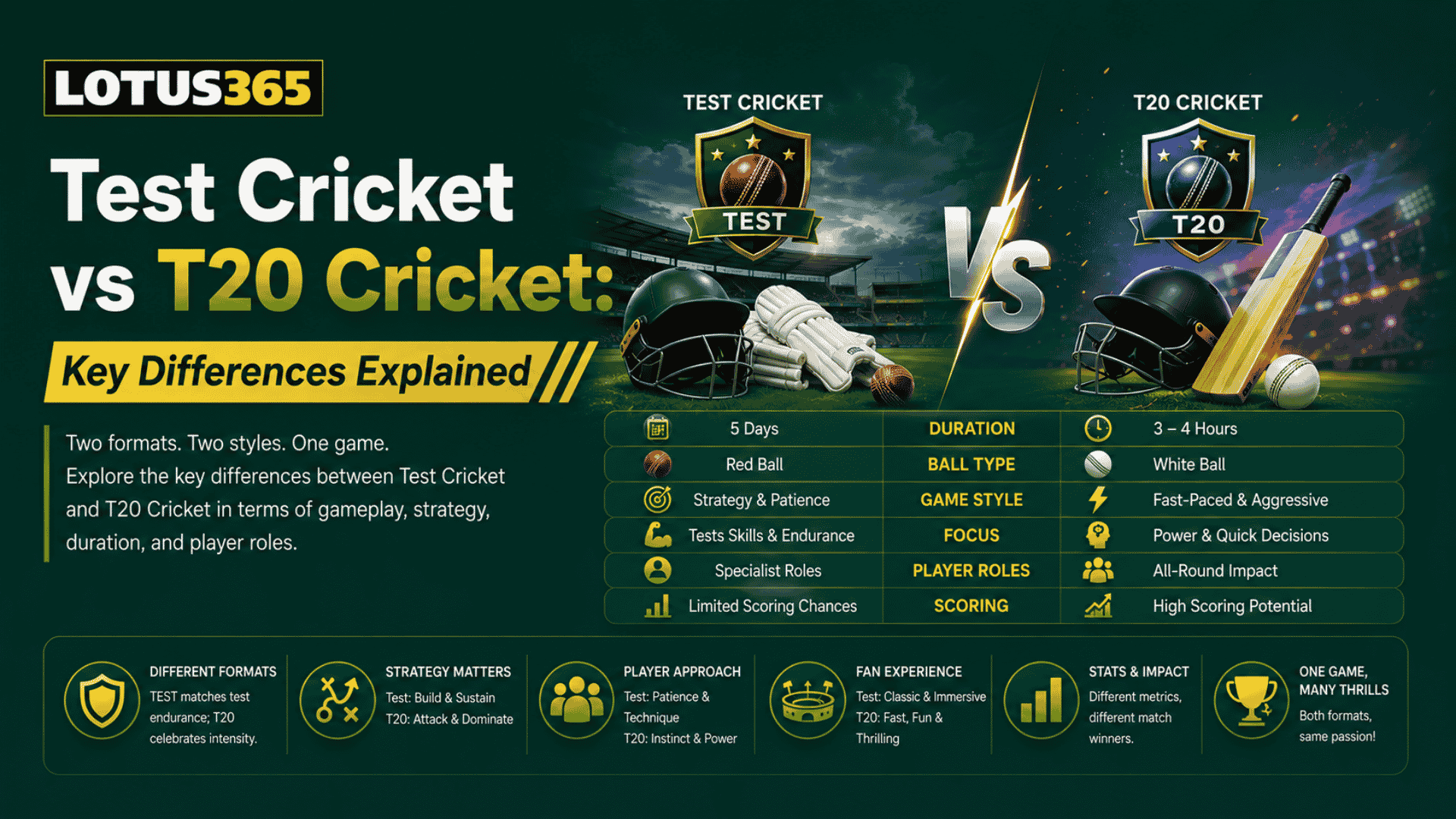
Cricket takes many forms but the long games and brief 20-over contests offer different experiences. Both involve runs, wickets, batting, bowling and fielding but the skills and the tactics required of the players are different. Understanding test cricket vs t20 cricket helps beginners to follow match situations, scorecards and team decisions.
What Is T20 Cricket?
The T20 is a limited overs format in which each side has a maximum of 20 overs. It’s the time factor that makes the Test cricket vs t20 cricket comparison clear – a T20 game is usually played out in a few hours but a Test can go on for days.
Twenty20 cricket was invented to make the sport more compact. The shorter 20-over format allows players fewer chances to recover from errors.
What is Test Cricket?
Test cricket is the longest form of international cricket and can stretch for up to five days. Teams get to set a score and bowlers get more chances to take wickets . Each side gets two innings . A match may end in a win, a loss, a draw or a tie. It is generally played in white clothing with a red ball and day/night matches use a pink ball. The first Test match to be recognized as such took place in Melbourne in 1877.
Match Length and Innings
The most notable difference between these cricket formats is structure. In a Test match each team bats twice but the second innings is not always required . Captains can plan for a much longer period of time as there is no fixed limit of 20 overs for the entire match.
In T20 cricket, a batting side is limited to a maximum of 20 overs. So every over is that bit more important, especially at the death. Anyone learning the basic rules of cricket, innings and overs are a good place to start .
Differences between Test Cricket vs T20 Cricket
| Feature | Test Cricket | T20 Cricket |
| Match duration | Up to five days | Usually a few hours |
| Innings | Up to two per team | One per team |
| Overs | No fixed 20-over limit | Maximum 20 overs per innings |
| Clothing | Usually white | Usually coloured |
| Ball | Red or pink | Usually white |
| Main focus | Patience and long-term strategy | Quick decisions and attacking play |
| Possible result | Win, loss, draw or tie | Win, loss or tie |
This comparison explains the need for different approaches for the two formats. In test cricket, you have the luxury of time to build pressure on the opposition. “In T20 you have to take quick decisions as there are limited number of deliveries in every over.
Batting and Scoring Method
The long form of batting is generally built around patience, defense, shot selection and concentration. A batter can take time to understand the pitch and the bowler before taking bigger risks. It may be better to build a long innings than score quickly.
“It’s a shorter game so I think the scoring rate is more important. Batsmen take advantage of limited deliveries with attacking shots, quick running and boundary hitting. But controlled batting is still important as losing wickets quickly can leave a team in trouble.
This is a big point in the test cricket vs t20 cricket debate, the same batsman may have to change technique and risk levels depending on the format.
Batting and Fielding Tactics
Bowling plans change too. In Test matches bowlers can work away at a batter over a number of overs, use different spells and wait for conditions to give them a chance. Captains have more time to set attacking fields and to develop a plan.
T20 has fewer overs so there is more pressure on each spell for the bowlers. Teams can divide the bowling duties between the powerplay, middle overs and final overs. When the batsmen are on the attack, slower balls, yorkers, changes of pace and accurate short deliveries can be useful.
Even in brief games, fielders need to be quick off the mark because saving the boundary can be as important as getting the wickets.
Rules and Playing Conditions for Tests
The longer format is easier to understand if you learn the test cricket rules. In a Test each side usually has two innings, and a captain may declare an innings closed before all the wickets have fallen. The result will be determined by runs, wickets and time available.
The rules of test match in cricket also allow a match to be drawn if time runs out without a winning result . Rain, poor light or other interruptions can reduce playing time and impact the result.
T20 Full Form & Format
The t20 full form is Twenty20 and it means that normally there are maximum 20 overs for each team. In a normal innings there can be as many as 120 legal deliveries but wides and no balls can add balls .
what is t20 cricket? The answer is simple: it is a limited-overs format in which each team normally has up to 20 overs to score more runs than the other. Its short structure drives quick decisions and gives weight to individual overs.
Team Selection and Player Roles
The players’ roles can vary based on the format. The longer game might favor the defensive technique and bowlers who can maintain accuracy over long spells. In brief matches specialists are often asked to hit big shots or bowl the last overs.
How Conditions Change the Game
Both formats are affected by pitch and weather conditions but the effect may change differently. A Test pitch can change over the course of several days, with teams able to adjust as the movement, bounce or spin develops.
In T20, teams have less waiting. Fast decisions are enabled by pitch pace, dew, wind and boundary size. A few overs can change the match and captains and players have to answer for that.
Before you go to online cricket id provider service, let’s understand how cricket scorecards and match formats work.
Why Fans Enjoy Both Formats
The long matches are good for the viewer who likes strategy, patience, technique and slow momentum swings. Short matches are characterized by quick action and fast changes on the scoreboard.
If you want to follow cricket, knowing the actual rules is still helpful, although a lotus gaming platform may include information on the formats of the sport.
Which Format Tests Players Differently?
There isn’t one answer to which format is harder. Test cricket is a game of concentration, stamina, technique and patience. T20 is a game of quick thinking, accurate execution, attacking skills and risk management.
Therefore, the test cricket vs t20 cricket comparison is best understood as a difference in the skills required, rather than a simple question of difficulty.
Learning the Game More Quickly
Beginners might start with runs, wickets, overs, innings, fielding positions and common dismissals. It is also helpful for someone lotus cricket id login to know how the scorecards and match commentary work.
Final Words
The test cricket vs t20 cricket comparison shows how different match formats present different tactical challenges. The longer format is about building up pressure, thinking ahead, the shorter version is about quick decisions and effective use of the deliveries.
Once you know the differences it makes it easier to follow cricket. When looking into a lotus online gaming service or a lotusexchange login, readers should start with the rules and scoring system.
FAQs
1. How long can a Test match go on?
A Test can be played over five days, although the weather, poor light or an early result can alter the amount of play.
2. How many overs are played in a standard T20 innings?
Normally each team is allowed a maximum of 20 overs.
3. What is T20?
4. Can players be good in both formats?
T20 is short form for Twenty20, the 20-over format.
Yes. Some players do well in all formats but they usually change technique, tactics and role.