
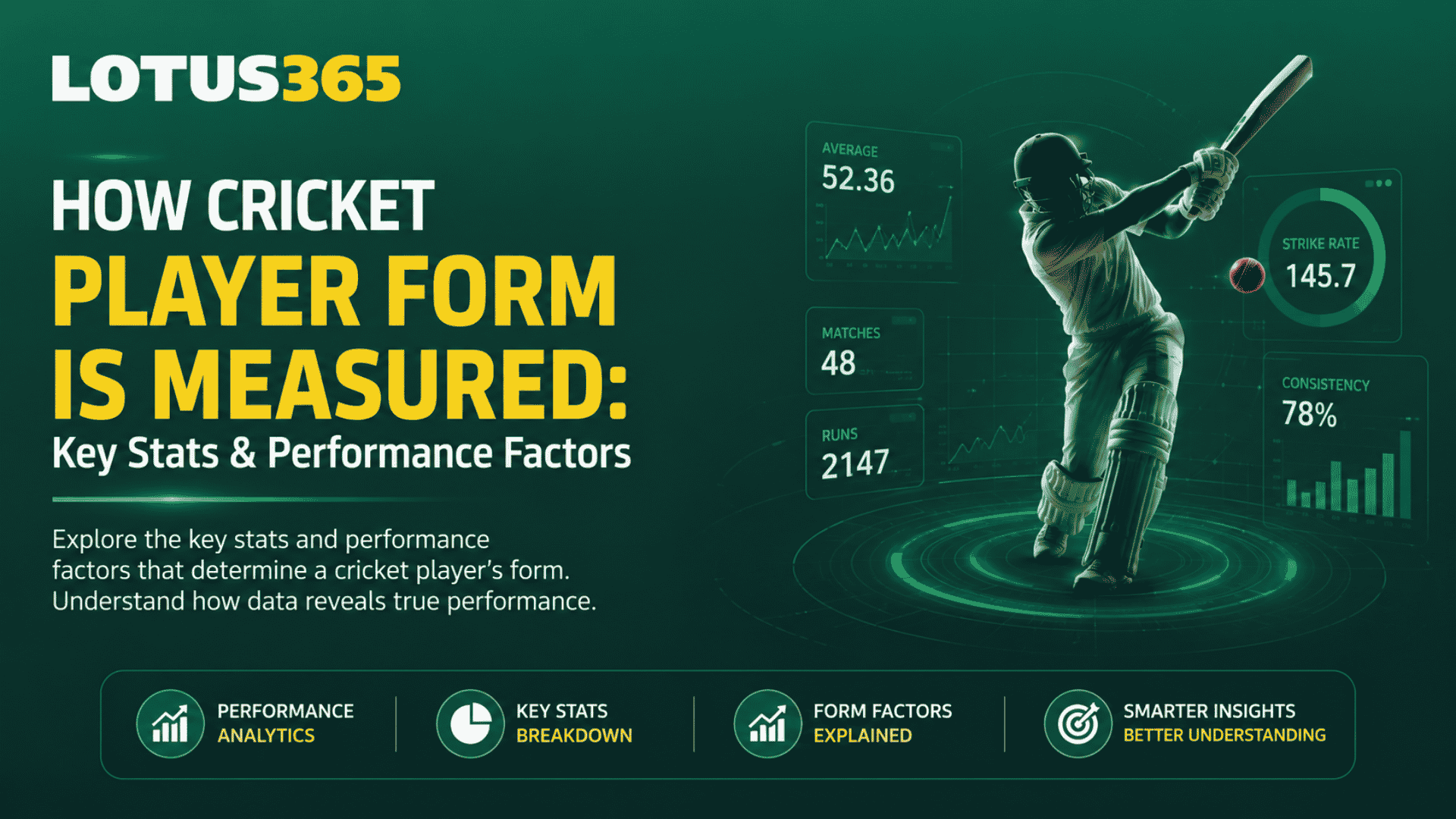
When a batter keeps scoring runs in every game or a bowler keeps taking wickets that’s a sign of good Cricket player form. Form isn’t just about numbers like runs or wickets. It also includes things like match situations, the kind of pitch, strike rate, economy rate and how well a player deals with pressure. All these factors together show whether a player is in shape or not.
Form helps fans and bettors make better decisions. It also helps teams plan like who should open, who should bowl at the death, and who needs support. So, instead of only watching one highlight clip, this blog shows how to measure cricket player performance step by step.
What Cricket Player Form Really Means
Cricket changes fast. A batter can start strong, then struggle for two matches. A bowler can take early wickets, then go expensive in the next game. That is why Cricket Player Form is always “moving.”
When people talk about Cricket players’ recent form, they usually mean performance over the last few matches or last few weeks. But the time window matters. For example, form in the last 5 matches may be different from form in the last 10 matches.
Also, form is not always “real skill.” Sometimes a player fails because:
- the pitch is difficult
- the team batting order is different
- the player got fewer overs
- weather changed or dew helped batting
- the player faced a stronger opponent
So, measuring form means mixing stats with simple match context. It becomes like checking both the weather and the road before starting a journey. Get the lotus cricket id to get updated performance results.
Cricket Player Form vs Cricket Player Performance Analysis
Many people mix up these two terms. Here is the easy difference.
- Cricket Player Form: what the player is doing lately
- Cricket player performance analysis: a bigger check of skill and impact (including form)
The form is like “today’s mood.” Performance analysis is like “what the player is good at overall.” Both are useful.
When you do Cricket player performance analysis, you look at patterns. For example, a spinner may not take wickets in one match, but their economy stays low. That can still show good form for controlling the game. ipl betting id provider helps to access the game without any issue and helps with the smooth complete player analysis.
So, Player Form in cricket should be measured using a few key Cricket player performance metrics, not just one number.
Cricket batting and bowling stats to track every time
To judge Player Form in cricket , always watch both batting and bowling sides. Even if looking for a batter, you should know what bowlers are doing. That helps match predictions in a simple way.
Below is a simple table showing which stats match which goal:
| Player Role | What you watch | Why it matters for form |
| Batter | Runs in recent matches, strike rate, balls faced | Shows scoring speed and consistency |
| Top-order batter | Average, contribution %, time at crease | Shows stability early in innings |
| Middle/finish batter | Runs in last overs, strike rate at death | Shows impact under pressure |
| Bowler | Wickets, economy rate, strike rate | Shows ability to take and control |
| Powerplay bowler | Early wickets, run rate allowed | Shows starting impact |
| Death bowler | Economy, dots per over, boundary control | Shows finishing pressure handling |
| All-rounder | Bat + ball impact | Shows form from two skills |
This table helps people understand Cricket batting and bowling stats quickly.
How to measure cricket player performance with “consistency signals”
Consistency means not only doing well once, but doing well again and again.
Consistency for batters
Look for:
- scores above 30 in multiple recent games
- fewer ducks
- regular conversion from 30s to 50s
Consistency for bowlers
Look for:
- getting at least one wicket often
- economy staying stable
- fewer matches with very expensive overs
These simple signals help identify Player Form in cricket without overthinking
Match context: pitch, role, and pressure
This is where many fans fail. Stats without context can mislead.
Pitch and ground type
- A flat pitch is best as the balls travel smooth.
- Turning pitch favors spinners as the ball grips the surface and turns more.
- Seaming pitch benefits bowlers, since the ball moves in the air and off the pitch.
Role in the team
If a bowler suddenly gets overs their wicket count might go down—even if their skill hasn’t changed. Similarly when a batter moves up in the order their chances to score often increase, even if they haven’t improved.
Pressure moments
T20 has huge pressure at death overs and powerplay. If a player is performing in those moments lately, the form is stronger.
This context makes your Cricket player performance analysis more accurate and calmer.
Common mistakes when judging Cricket player recent form
Here are errors people make again and again in Cricket player recent form :
- Only checking total runs or total wickets
- Ignoring match phase (powerplay vs death)
- Ignoring pitch type and match situation
- Using only one match as proof
- Forgetting the player role (opener, finisher, strike bowler)
If you avoid these mistakes, your Cricket player performance metrics will become more meaningful.
Example: how a batter’s form looks in 5 matches
Imagine a batter scored:
- 0, 18, 35, 42, 50
This shows improvement. Even though the first match was a duck, the next scores rise. That is usually good Player Form in cricket if the strike rate also improves and boundaries increase.
Now imagine another batter:
- 12, 12, 13, 14, 15
That might look “consistent,” but the player is not making big starts. Depending on match type, form may still be weak.
So always combine runs with impact.
Example: how a bowler’s form looks in 5 matches
Imagine a bowler has:
- economy 7.5, 6.8, 7.2, 6.9, 8.1
- wickets: 1, 2, 1, 3, 0
Even with one match without wickets, the economy stays good. That can be a strong form, especially if the bowler also bowls dots and restricts boundaries.
This is why measuring form should not be only “wickets = form.”
How fans use Cricket Player Form for smart betting decisions
Many people look at forms for match selection, and that can be used responsibly. Form helps you avoid random guessing.
If a batter has great strike rate recently and the pitch supports batting, that can mean a higher chance of a strong batting impact. If a bowler has controlled economy and is taking wickets at key times, their wicket or economy-related outcomes can look more reasonable.
This kind of thinking is aligned with how sportsbooks show markets for players based on recent form and match situations.
If looking for support and platform guidance, use the help number from Lotus 365 App for proper account and product help.
(Use responsibly gambling is not for everyone. Always follow responsible gaming steps.)
Where to get updated stats and reliable info
Competitor sites often mix things. Some pages show numbers but hide the source. That can mislead. Here is how to stay safe:
- Use official scorecards and match reports
- Check stats across more than one match window
- Look for the same pattern in batting and bowling
- Be careful with claims that look “too perfect”
lotus 365 website often talks about live updates and clear user experience. For users who want smooth match reading and quick access, the App can help reduce confusion during live matches, but always verify match context using score sources.
Conclusion
Cricket Player Form is not a mystery. It is a mix of Cricket batting and bowling stats, recent consistency signals, and simple match context like pitch and role. When a batter scores with confidence and strike rate stays strong, that is good form. When a bowler keeps economy low and takes wickets at key moments, that is also real form. Use the checklist, avoid common mistakes, and always check more than one match. If you want a smooth experience while tracking lotus365 vip apk markets, explore lotus 365 and stay updated through the App. Bet and enjoy the game.
FAQs
1. What is Player Form in cricket in words?
The performance of the player in the matches and also the role played, match situations are all called as Player Form in cricket
2. How to measure cricket player performance for a T20 match?
Player performance is measured by strike rate, boundaries, score impact, economy rate, wicket timing and how often they bowl.
3. What does Cricket player recent form mean exactly?
A cricket player’s recent form means how the player performs in the game and how consistent the player.
4. Which matters more: wickets or economy, for bowlers?
Both matter. Wickets show attacking power. The economy shows control. A bowler can still look in form even if wickets are low as long as runs are controlled and pressure is built.
5. How do Cricket batting and bowling stats work together to judge form?
If batters are scoring faster and bowlers are leaking boundaries match results may change. Checking both helps you understand whether the player’s form fits the game situation.
6. Why does form look different on pitches or grounds?
Pitch type changes how easy batting or bowling is. Weather and dew can also change who benefits. That’s why you should not judge form by one match.
7. Is it safe to use Cricket Form for predictions or betting?
It can help you make thoughtful decisions but it is never 100% sure. Use matches, check context and avoid relying on only one game outcome.