
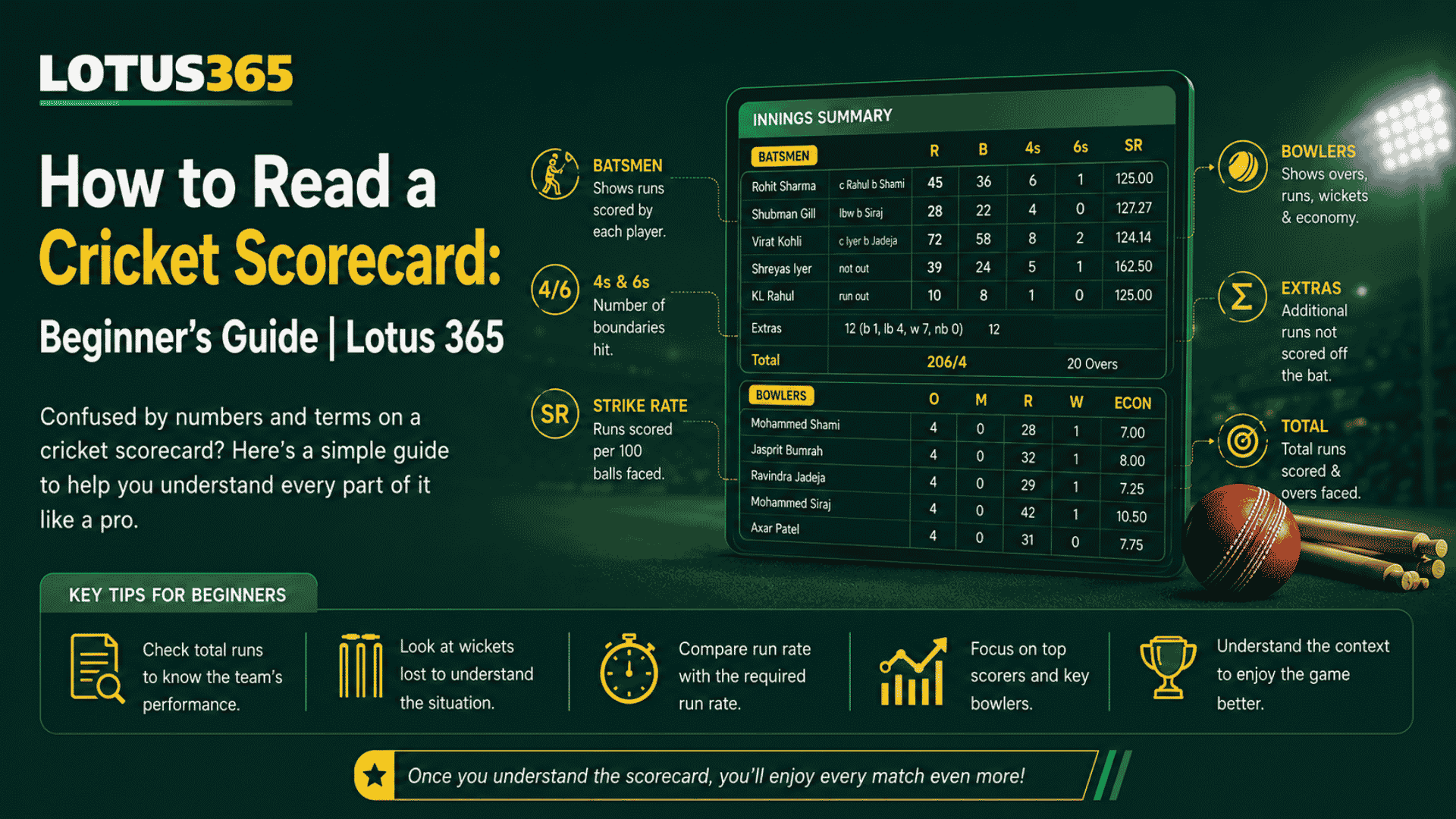
One of the simplest ways to figure out what happened in a cricket match is a cricket scorecard. It keeps count of runs, wickets, overs, batting performances, bowling figures, extras, partnerships and the final result.
Once you know the basic terms you can read a scorecard quickly and understand the development of an innings.
What Is a Cricket Scorecard?
A cricket scorecard is a written record of a team’s performance in a single innings. Generally shows team total, wickets, overs, batting figures, bowling figures, extras, fall of wickets, partnerships and result.
This means that the team has scored 168 runs and lost five wickets. If followed by 20 overs, the team finished its allotted 20 – over innings.
Find the batting team first, total runs, wickets lost and overs completed. These details immediately tell you the basic match situation.
Understanding the Main Cricket Score
The main cricket score tells you how many runs a team has scored lotus online game and how many wickets it has lost. 120/2 is a whole different game to 120/8, even if the teams have made 120 runs. During a chase, check target, runs required, balls remaining.
How to Read Overs and Balls
Cricket is played with a six-ball over. Scorecards do not show overs in normal decimal figures. So if you see 14.3 overs, that means 14 full overs and three legal deliveries in the next over.
Therefore, 14.3 does not mean fourteen and three-tenths overs. It represents 87 legal balls.
Wides and no-balls are not counted as legal deliveries, so an over may have more than six actual deliveries. This comes in handy when you need to check scoring rates or work out the balls remaining.
Reading the Batting Table
The batting table shows each batter’s contribution to the team total. Common columns are: player’s name, dismissal, runs, balls faced, fours, sixes, strike rate.
Runs show the batter’s individual score, and balls show the number of deliveries they faced. The fours and sixes columns are for boundaries scored.
The “dismissal” column explains how a batter was dismissed. The most common dismissals are bowled, caught, lbw, stumped and run out. The batsman at the crease was not out when the innings finished or the target was achieved.
Understanding Strike Rate
Strike rate is a measure of a batsman’s scoring rate in limited overs cricket. The formula is runs per balls faced x 100.
48 from 24 balls is a strike rate of 200 for example.
A high strike rate means that you score faster. But the state of the match is important as a batter may play conservatively when wickets are falling.
What Are Extras?
Extras are team runs which are not normally credited to a batter. The main types are wides, no-balls, byes and leg-byes.
Wide – A delivery that is out of the reach of the batter, having regard to the circumstances under which the match is played. A no-ball is an illegal delivery under the Laws of Cricket scorecard and is penalised.
A bye is scored if the ball passes the batter without touching the bat or the body. A leg bye is when the ball hits the batter’s body in the way allowed by the Laws.
Extras can make a big difference to the final team total.
How to Read Bowling Figures
The bowling section generally includes overs, maidens, runs given away, wickets and economy rate.
Economy rate: Average runs conceded per over. A bowler who concedes 24 runs in four overs has an economy rate of 6.00.
Wickets matter but runs conceded, economy, maidens and match conditions also help to provide context.
Understanding Partnerships and Fall of Wickets
A partnership is the runs made by two batsmen while they are together at the wicket . A 90-run partnership could indicate how the team bounced back from an early wicket.
The fall-of-wickets column records the score when each wicket was taken. The progress of the innings is indicated in entries at 25, 76, 119, 150.
They help to identify periods of pressure and stable partnerships.
How to Use a Live Scorecard
A live scorecard updates as the match is being played. It could display the current score, wickets, overs, batsmen on strike, current bowler, recent balls, partnership, target, and required run rate.
A cricket live scorecard is very handy if you can’t watch every ball. You can get a quick understanding of the match situation by checking the latest score, wickets and overs.
When you follow cricket through an app like lotus 365 apk, make sure the source is reliable and secure.
Reading a Cricket Match Scorecard
The completed cricket match scorecard provides the full record after the game. Compare both team totals. Batting. Bowling. Extras. Partnerships. Fall of wickets.
Close results may have been due to good partnership or economical bowling or pressure in the death overs.
Understanding Required Run Rate
Required run rate is the rate at which a batting team needs to score to be able to reach the target in a chase.
Suppose a team requires 72 runs off 48 deliveries. It’s gotta be scoring at nine an over.
See the rate needed with wickets and balls to go. If you have a few wickets in hand you can cope with a high rate.
Understanding Cricket Statistics
There is more to cricket statistics than just one innings. Batting statistics usually include runs, average, highest score, strike rate, fours and sixes. Bowling statistics can include wickets, economy rate, average, maidens and bowling strike rate.
“Stats are more useful over multiple matches. One big score is not always consistent.
If you access a cricket related service using a lotus id login, the account information is not the same as the official statistics displayed in a scorecard.
Scorecards and Cricket Betting
A scorecard is a record of cricket events, it is not a guarantee of future outcomes. A person who is studying lotus cricket betting may review recent scores, player form or team statistics but these numbers cannot forecast a future result with certainty.
A scorecard is not a guarantee, it is match information. Everyone who participates in betting must be aware of the risks and obey the law that applies.
Frequently Asked Questions
1. What does 150/4 mean?
It means that the team scored 150 runs and lost four wickets.
2. What does 18.2 overs mean?
That’s 18 full overs and two legal deliveries into the next over.
3. Why are extras shown separately?
Extras are team runs not usually charged to an individual batter, such as wides, no-balls, byes and leg byes.
4. How can beginners understand a scorecard quickly?
Start with aggregate, wickets and overs. Next look at the main batters. Bowling figures. Extras. Partnerships and fall of wickets. During a chase check the target and required rate.
Final Thought
Once you know what each part of a cricket scorecard means, it’s easy to learn how to read it. Total score, wickets and overs, then batting figures, then bowling performance, then extras, then partnerships and fall of wickets.
A scorecard records how an innings was built, who contributed, when wickets changed the game and how quickly runs were scored. A scorecard is also different from a lotus online game or some other online gaming product too. It’s a real record of cricket performance.
Reading these details together helps you get a better understanding of cricket and match strategy for beginners, without the need for advanced cricket knowledge or experience.