
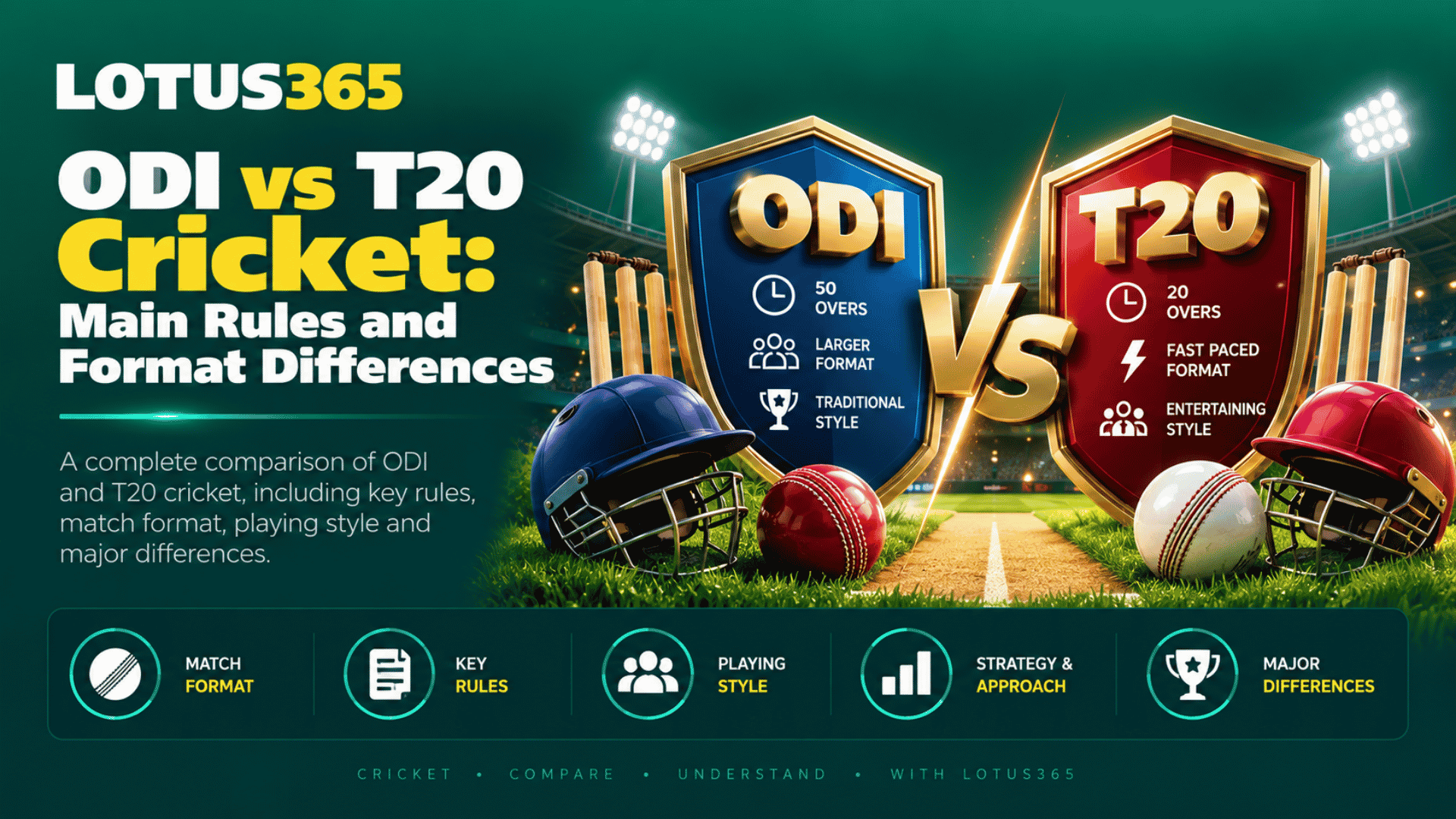
Cricket looks familiar in every format, but the experience changes with the number of overs. One game allows batters to settle in, the other requires them to go on the attack from ball one. Indian fans watch this in an India match. In this guide I will set out the rules, theory, tactics and differences in English without turning cricket into a maths lesson.
ODI vs T20 Cricket: Understanding the Basic Format
To know ODI vs T20 Cricket, start with the overs. An ODI gives each team up to 50 overs while a T20 gives each team up to 20 overs. This has an impact on batting plans, bowling changes, field settings and the taking of risks.
If India are chasing 280 in an ODI, then the batting side can build partnerships before going on the attack. If you hang around too long in a T20 chase you can get into trouble because you only get 120 legal balls. For better understanding of scorecards, a fan following cricket information on a lotus365 platform can keep this basic difference in mind.
What Is the ODI Cricket Format?
The ODI cricket format allows each side up to 50 overs. A match can last for as long as 100 overs, but rain or an early result can shorten it.
An ODI innings has three stages:
Powerplay: Fielding restrictions offer attacking chances.
Middle overs: Batters rotate strike, form partnerships, protect wickets.
Death Overs: Teams look for boundaries and aim to score at a higher rate
The premise is straightforward: an ODI team has time to recover from a slow start or early wickets. A batter doesn’t have to hit every ball. Singles, twos, gaps and partnerships can quietly make a strong total.
The Indian pitches too play their part. A slow pitch might reward patience. A flat surface might make stroke-making easier. ODI cricket is about using 50 overs wisely.
What Is the T20 Cricket Format?
T20 cricket format is where each team bats for 20 overs. One big over can change a match, so an over is important. The main T20 cricket rules do help positive cricket but you have to plan smartly. Batters look to score, bowlers have variations and captains change fields quickly
There are three stages to a T20 innings:
Powerplay: Restrictions on fielders, batters often hit the field.
Middle overs: Teams look for good matchups and try to keep the run rate ticking over.
Final overs: Greatest emphasis is on boundary hitting.
Think of an Indian opener scoring 45 off 25 balls. That can be a useful T20 innings as the batter has got on to his score quickly. The same score needs a bit more context as an ODI.
You see cricket conversations related to lotus cricket betting remember T20 scoring takes off. Before interpreting match-related numbers, it helps to understand the format.
ODI vs T20 Rules: What Actually Changes?
The ODI vs T20 rules have the cricket foundation: runs, wickets, overs, dismissals, fielders and partnerships. The real difference is time available.
The major changes are:
Overs: Up to 50 per side in ODI; up to 20 in T20.
Duration of match: ODI matches tend to be much longer.
Batting: In an ODI you can build a slow innings, in T20 you generally have to score more quickly.
Bowling: ODI bowlers have more overs to bowl.
Recovery: ODI sides have more deliveries to redeem a bad start
Pressure: T20 pressure compressed into a shorter period.
Difference Between ODI and T20 Batting
The difference between ODI and T20 batting is largely about time, risk and scoring speed. In an ODI, a batter might spend several overs reading the pitch before going on the attack. There is not much luxury in T20.
An ODI player can play vital innings like scoring 80 off 90 balls. In T20, 50 off 30 balls can be huge as the run rate is faster.
T20 batting is more than just crazy hitting. Good players have shot selection, running, field awareness, matchups, controlled hitting of the boundary. A batsman could hit out at a spinner but only take a single off a difficult bowler.
Anything to do with check account info like lotus id login should be separate from cricket analysis. Match formats explained Rules, scorecards and stats
Bowling Strategies in ODI and T20
Bowling changes plans in all formats. In ODI, bowlers can use swing, spin, pace and variations to build pressure over a number of overs. T20 bowlers have less margin for error. Captains can pick them on batter matchup, powerplay or final overs.
The standard T20 options are:
- Yorkers
- Slow balls
- broad strokes
- Short balls
- Spin Variants
Why ODI vs T20 Cricket Powerplay Matters
Powerplay periods matter because restrictions on fielding can create scoring opportunities.
The basic idea is simple. Early overs can give batters more scope to get boundaries. T20 teams tend to attack more because quiet overs are expensive. But ODI teams can be aggressive and preserve wickets at the same time.
Here’s the thing: In T20 every over matters. There is more breathing room in ODI.
Scoring Rate and Match Pressure
One reason the formats feel different is the run rate. It is simple. If a team needs 100 in 10 overs, it has to score at 10 runs an over. That creates pressure in a T20 because the number of deliveries left is small.
ODI vs T20 Cricket also emphasizes the value of context in statistics. The gist is simple: stats don’t mean anything unless you know the context behind them. Runs, strike rate, economy rate and wickets should be read with overs, pitch conditions, wickets remaining and match equation.
Real Match ODI vs T20 Cricket
It is easier to understand chasing in ODI and T20 Cricket. Say India needs 70 runs off 60 balls in an ODI. The batting side can choose to play controlled shots, take singles and the occasional boundary.
Now consider needing 70 from 30 balls in a T20. Pressure immediately goes up. Batters need boundaries Running is the key and bowlers know one expensive over can change the game.
Are you a reader looking for service information such as lotus365 contact number? Keep it separate from cricket rules. The contact information does not describe how to play an ODI or T20 match.
Understanding ODI vs T20 Cricket Terms Separately
The rules of cricket are different to the terms of service online. For instance, an ipl betting id provider is a service related term and not a part of the official ODI or T20 rulebook.
Learn the sport first, then find a separate platform, account or service separately.
Final Thoughts
ODI vs T20 Cricket compares two different paces of limited over cricket. ODI allows teams more time to build, recover and change plans. T20 forces you to condense those decisions into 20 overs and makes every phase more urgent.
The lesson is simple. The foundations of cricket remain familiar, but fewer deliveries change the way players think. Once you get that, scorecards and tactical decisions start to make sense. Indian chase, late six, tight final over, the format explains why the game can feel so different.
Frequently Asked Questions
1. What is the difference between ODI and T20?
The big difference is overs.Each ODI side can be 50 overs, each T20 side 20.
2. What are the basic rules of T20 cricket?
Each team tries to score as many runs as possible within a maximum of 20 overs.
3. Is One Day International cricket slower than T20?
Yeah, most of the time. In T20 it is quicker scoring, quicker decisions, in ODI it is more time to build an innings.
4. What is the importance of strike rate in T20?
The faster you score in just 20 overs the more difference it can make to the team’s final total.
5. Can a player be successful in both formats?
Yes. “You can do well in both, but you have to change your approach according to the format.